
Flores and Komodo Birding Trip Report – April 2026
SUMMARY
One of the most popular birding trips in the Lesser Sunda Islands is the Komodo–Flores Bird Watching. These trips range in duration from a short 3-day trip to a medium 7-day trip. These trips offer a journey that encompasses Flores' endemic species and the unique biodiversity of Komodo Island, where the legendary Komodo dragon resides in its natural habitat.
Our clients were two birders, researchers, and activists from India: Shreshtee and Ashish. The trip began in Labuan Bajo on April 6, 2026, and ended in Labuan Bajo too, on April 10, 2026. Despite daily rain interruptions, the birding trip went very smoothly and yielded excellent results.
Trip Details
The first day was a non-birding day. Shreshtee and Ashis arrived in the late afternoon. They went straight to the hotel and rested for the night.
On the second day, our birding location was the Mbeliling forest area. Departing the hotel at 5:30 a.m., we headed to Melo. Morning birding along the way managed ti pack a few targets: Spotted Kestrel, Flame-breasted Sunbird, Black-fronted Flowerpecker, Wallacean Cuckooshrike, and Flores Crow. Our main location as usual was Puarlolo. Here, we successfully captured several key targets: Flores Monarch, Variable (Lesser Sunda) Goshawk, Flores Minivet, Pale-shouldered Cicadabird, Dark-crowned Heleia, Russet-capped Tesia, and Yellow-spectacled Heleia.
Interrupted by rain during our lunch break, we decided to bird in the lower elevations, close to te coastline, on the rice fields south of Labuan Bajo. Although we had to stop early due to rain (again!), we managed to catch our targets here: a Small Blue Kingfisher and a Pale-headed Munia. After a short rest at the hotel, we returned to this location to look for Moluccan Scops-owls, which were very cooperative. The pair of owls were quiet and stayed in the same tree for long periods.
The followig day was our sailing day. The weather was clear in the morning. We departed before it was fully light. took a private speedboat straight to Komodo Island. We were the first to arrive at Komodo. Some of the species we encountered from our speedboat included: Black-naped Tern, Great Crested Tern, Pied Imperial Pigeon, Red-necked Phalarope, Pacific Reef Heron, Lesser Frigatebird, and White-bellied Sea-eagle.
In Komodo, we went on a long trek. We had the opportunity to encounter active Komodo dragons several times. Our main target bird was the Yellow-crested Cockatoo. We found them nesting and perched nearby several times, with clear visibility, and good photos. We also encountered numerous Green and Pied Imperial Pigeons feeding in big flocks on the palm tree, Tenggara Whistler, Black-naped Oriole. By midday, we were back in Labuan Bajo.
After a lunch break at the hotel, we drove to Ruteng. Several stops along the way resulted in encountering one of our more difficult targets: a Southeastern Hill Myna, which perched on the roadside, and we managed to get a great view. We arrived in Ruteng as it was already dark. We headed straight for Ranamese. Our primary target, and also the main target in Ruteng, was the Flower Scops-Owl. That night, it was very responsive to playback. Within minutes, it was calling near the road where we were standing. After venturing a few meters into the forest, we found it perched for quite some time in the canopy.
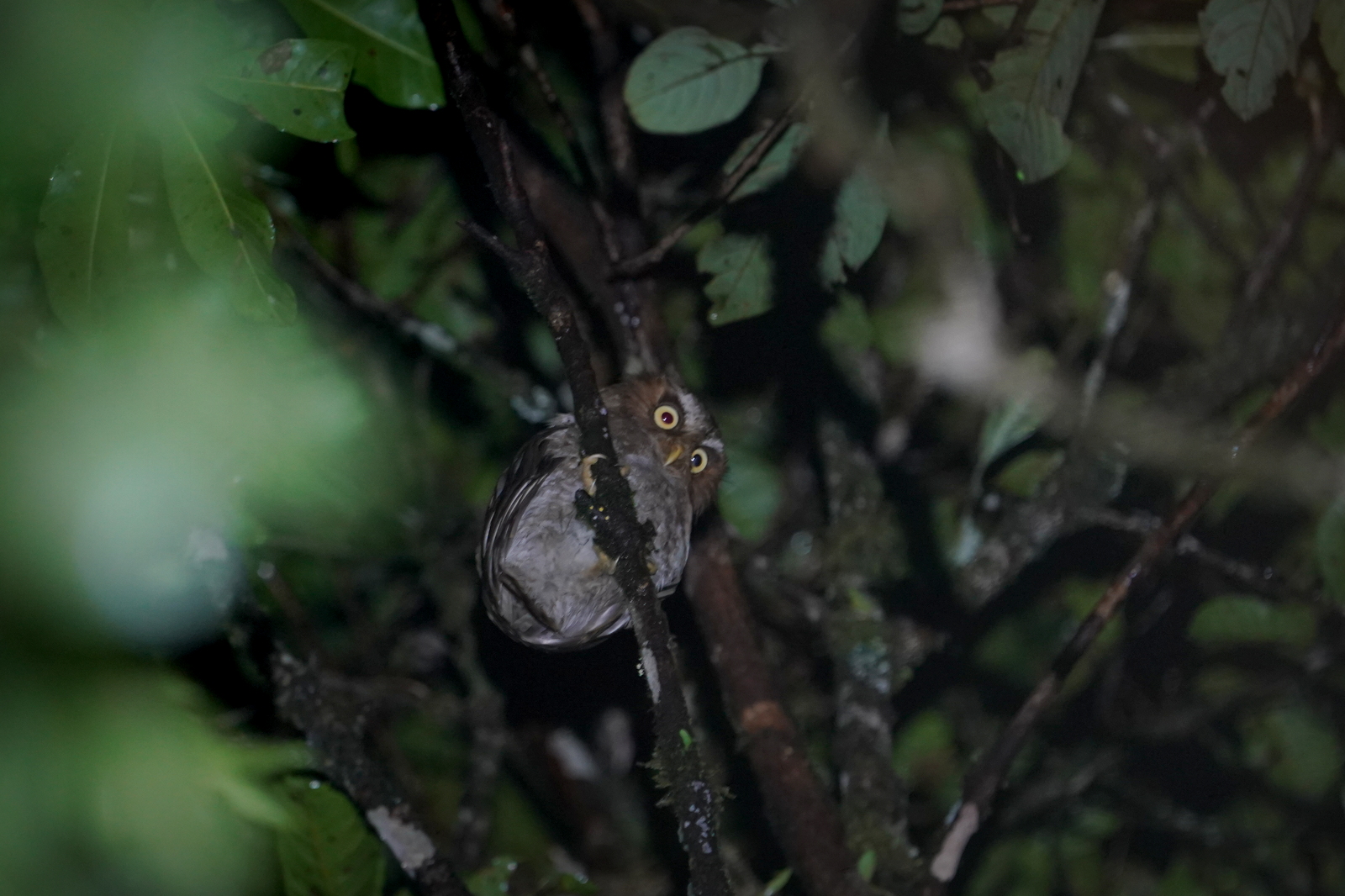
Flores Scops-Owl in Ranamese
On the fourth day, we birded in Gololusang, a hilly area south of Ruteng, which is a prime birding location in Ruteng. Our target species captured here included: Chestnut-backed Thrush, Bare-throated Whistler, Flores Leaf Warbler, Flores Jungle Flycatcher, Flores Minivet, Brown-caped Fantail, Eye-browed Heleia. Unfortunately, it was raining and the fog was thick. We decided to descend to a lower location north of town. Here, we managed to catch White-rumped Kingfisher, Russet-caped Tesia, Crested Heleia, and Banded Fruit-dove.
After lunch, we returned to Gololusang to catch some important targets that had not been captured. We only had less than 30 minutes before we gave up because the rain returned. Despite this, we still caught our important targets: the Lores Flowerpecker and Scaly-crowned Honeyeater.
We left Ruteng for Labuan Bajo amidst heavy rain. Fortunately, a few kilometers out of Ruteng, the weather improved. We had the opportunity to visit one of the beautiful traditional Manggarai crafts, Lingko: a rice paddy field shaped like a spider's web. Not only did we witness the beauty of the Lingko, but we also recorded several target species here, including Wallace's Heleia, Ashy-bellied White-eye, and Spotted Kestrel. Arriving in Labuan Bajo in the late afternoon, we headed straight to the hotel after dinner.
Day five was the final day of the trip. We planned to return to Puarlolo to catch some missed targets. However, since we only had a few hours, Shreshtee and Ashish decided to bird around Labuan Bajo. Some targets we had previously captured but still needed to be seen again included Wallace's Heleia, Zebra Finch, Flame-breasted Sunbird, Black-naped Oriole, Sunda Collared Dove, and Thick-billed Flowerpecker.
After breakfast at the hotel, we tried our final location, the grounds of the Puri Sari Hotel. The grounds of the Puri Sari Hotel are a promising birding hotspot. We managed to catch one of our top targets this time, the Ornate Pitta.
The Ornate Pitta was a sweet end to this trip, before dropping Shreshtee and Ashis off at the airport for their trip to Jakarta for several meetings in Bandung.